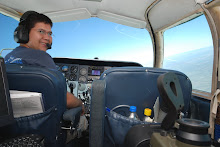
Piper Snow-Cone

4:30 AM, my pager startles me awake with a loud rattle on the night stand next to me. "Are you awake? Don't forget to check in with dispatch" I fumble for the light switch in the dark of an unfamiliar hotel room in Monrovia, CA and feel my way to speed-dial #7 on my cell phone. I've only had six hours of sleep, and my dispatcher doesn't realize that there is an hour time difference between California and Arizona. I mumble a few words to her she apologizes profusely but the damage is already done, there was no way for me to fall back asleep for another hours rest. I brew a pot of hotel coffee and call up for my weather briefing.
The briefer answers with alacrity after the first ring and I mumble my way through my route of flight. The briefer takes a deep breath and starts rattling off SIGMETS, AIRMETS, METARS, TAFS, winds alofts, and NOTAMS at mach two all in one sentence. I listen carefully as I sip my coffee, my brain pops into gear and catches up. This morning was going to be different from every other flight that I've had since working at Sun Western. I was going to have to file IFR! Overcast at 3,000 feet but no reported tops as of yet in the morning. No problem, I've flown through this sort of marine layer a number of times before it probably only a couple of thousand feet thick. I put my flight plan on file and hang up with the briefer. Quick shower, suit up and drive to the airport.
Within a minute of taking off I plowed my way through the bottoms of the clouds. The aircraft bounces around like driving on a dirt road. I focus my attention on the instruments as the controller speaks "Saratoga One Two X-Ray, Turn direct Paradise climb and maintain 8,000 feet." I bring the nose slightly up and expect to punch out of the clouds soon. The grey cloud surrounding me slowly turns to pure white as I get closer to the top of the layer. The temperature drops as I climb and upon reaching 8,000 feet I dip the nose down to level off then check the temperature probe that sticks through the front window: 32 degrees F. Small water droplets from the cloud that were just blowing off the windscreen stop dead in their tracks. The probe poking out my window turns white with what looks like shaved ice, the backs of the rivet heads on the wings start collecting semi-circular ice rings. Ice on the wings can change how the airplane handles and causes a loss of lift. Since the airplane I fly does not have any way of removing ice from the wings in flight this can very quickly turn into a critical situation. I want to climb higher to get on top of the clouds and out of the ice.
I call up on the radio: "SoCal Approach, Saratoga 12X requesting an immediate climb higher due to light rime icing, I'm not de-ice equipped." SoCal replies, "Roger, 12X Stand-By" then starts telling airliners above me and around me to turn, climb or descend in order to make a hole in the densely packed airspace over Ontario for me to climb up through. I appreciate the power of the controller. To a little Piper pilot like me, ATC's power is equal to the power of Moses as he parted the Red Sea. Soon enough my clearance to climb to 11,000 feet comes through. I bring the nose up a couple of degrees and punch through the top of the cloud. I feel immediate relief when the sun warms my face as I climb eastbound into the sunrise. My hard work is paid off by a beautiful view out the captain side window of the early morning colors of brilliant orange, light pink and pure white painted on a sea of cotton ball clouds beneath me. The wings sparkle where the ice collected.
Outside, the winds are howling at 50 knots from the west. My ground speed is 230 MPH. I expect strong turbulence over the top of the very tall mountains just west of Palm Springs and as I approach the mountains I throttle back to slow the plane down to its rough air penetration speed and tighten my seat belt as the plane starts rocking around. I do my best to keep the nose pointed East. As I cross over the top of the mountain range I pull the throttle back almost to idle and spiral two miles down to Bermuda Dunes Airport with winds favoring runway 28 with a stiff crosswind from the left. On final approach I bounced around flying sideways and in the last few seconds applied full right rudder and a bit of left bank to pull the nose over to land firmly on the runway.